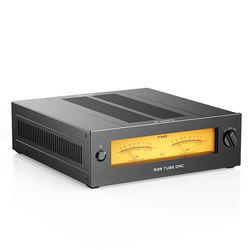
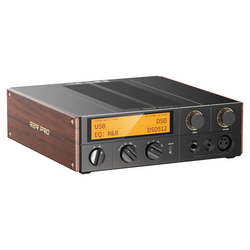
FIIO DP11
The FIIO DP11 is a compact desktop CD player that also functions as a digital transport and USB DAC. CDs can be played directly through the analog output, while the digital signal can be sent to an external DAC via various digital outputs. Via USB, the DP11 can also be used as an external DAC for a computer, smartphone, or tablet. Additionally, it is possible to rip audio CDs directly to a USB flash drive as WAV files without a computer.
Special CD mechanism for desktop use
The DP11 features a specially developed CD tray mechanism designed for use on a desk or audio cabinet. Custom servo firmware, combined with a silent suspension system, ensures stable operation of the drive. The tray opens and closes smoothly, while the CD is reliably read during playback. For precise timing, the DP11 uses two femtosecond clocks with low phase noise.
Separate internal architecture
The internal architecture of the FIIO DP11 is based on the design of the S15 desktop streamer. The CD servo, the digital section, and the analog section are physically separated from one another and each has its own power supply. This minimizes mutual interference and noise, keeping the background of the audio signal quiet.
The digital outputs have also been carefully designed. Both the coaxial and AES/EBU outputs utilize isolated digital transformers, which further minimize ground loops and unwanted interference.
High-Quality Analog Output
For the analog output, the DP11 uses a Cirrus Logic CS43198 DAC. This converts the digital signal to a stereo RCA output with an output level of 2.2 Vrms. This allows the DP11 to be connected directly to an amplifier or active speakers.
The analog output features a signal-to-noise ratio and dynamic range of at least 109 dB. The THD+N is less than 0.0014% during CD playback and less than 0.00068% during USB playback, enabling the DP11 to deliver accurate and transparent signal reproduction.
Versatile Digital Transport
As a digital transport, the FIIO DP11 offers three different digital outputs: AES/EBU via XLR, coaxial, and optical. Signals up to 192 kHz/24-bit can be transmitted via AES/EBU and coaxial. The optical output supports resolutions up to 96 kHz/24-bit.
| Afmetingen (HxBxD): | 213 x 230 x 67 mm |
| Garantie: | 2 years |
| Omvang van de levering: | FIIO DP11, Remote Control, USB-C to USB-C Data Cable, Power Cable |
| Gewicht: | 1802 g |